
First-time authors often make common writing mistakes that affect story structure, character development, and overall readability. These mistakes include starting without a clear direction, weak character motivation, lack of conflict, poor pacing, and rushing the revision process. Understanding these issues early helps writers improve their storytelling, avoid unnecessary rewrites, and complete a stronger manuscript.
Writing your first book is one of the most exciting things you’ll ever do and one of the most terrifying. Whether you’re working on a literary novel or a fast-paced thriller, the journey from blank page to finished manuscript is full of unexpected traps.
Many first-time authors fall into the same pitfalls, not because they lack talent, but because nobody warned them. If you’re serious about your writing craft, professional book writing services USA can help you navigate the process — but first, let’s talk about what’s standing between you and a book you’re proud of.
Over the years, I’ve worked with hundreds of aspiring writers who came to me frustrated, stuck, or ready to throw their manuscripts in the trash. Almost every time, the problem wasn’t their story idea — it was one of these ten common writing mistakes. Let’s walk through them honestly.
Common Writing Mistakes First-Time Authors Make
| Mistake | What Goes Wrong |
| No Clear Direction | The story starts without a plan and quickly loses focus |
| Weak Character Motivation | Characters feel flat and lack purpose |
| Ignoring the Inciting Incident | The story takes too long to become interesting |
| Lack of Conflict | No tension or stakes to keep readers engaged |
| Wrong Point of View | Switching POV confuses the reader |
| Rushing the First Draft | Leads to plot holes and weak structure |
| Skipping Editing | The manuscript feels unpolished and incomplete |
| Poor Publishing Knowledge | Authors struggle with formatting and distribution |
| Writing in Isolation | No feedback leads to missed mistakes |
| Letting Fear Take Over | Writer loses confidence and stops progressing |
Mistake #1: Starting Without a Clear Story Direction

Most first-time authors dive straight into Chapter One without any sense of where the story is going. They have a cool character, a vague premise, and a lot of enthusiasm — but no narrative backbone. Three chapters in, they’re stuck.
Think of it this way: if Cinderella’s story had no ball, no glass slipper, no midnight deadline — what would we even be reading? The magic isn’t just in the character; it’s in the plot structure that creates tension and keeps the reader turning pages.
Before you write a single scene, spend time figuring out your story’s arc. Where does it begin? What’s the inciting incident that changes everything? Where does it end? You don’t need a rigid, chapter-by-chapter outline, but you need a destination. (If outlining feels overwhelming, read this blog on how to outline a book — it’ll save you weeks of confusion.)
Mistake #2: Writing Characters Without Real Motivation
Here’s something I tell every writer I work with: readers don’t follow plots — they follow people. And people are only compelling when they want something badly enough that they’ll bleed for it.
Think of the mother in Stephen King’s Carrie. Her motivations aren’t complicated, but they’re ferociously real. Her beliefs, her fear, her love twisted into something destructive — all of that makes her unforgettable. If she were just “a mean character,” we’d forget her by page two.
Ask yourself: what does your main character desperately want? What are they afraid of? What do they stand to lose? When you know those answers deeply, every scene writes itself. Character motivation isn’t a nice-to-have — it’s the engine of your entire story.
Mistake #3: Ignoring the Inciting Incident
Why Your Opening Paragraph Sets Everything in Motion
First-time authors often spend chapters “setting up” their story before anything actually happens. By the time the inciting incident arrives, the reader has already checked out.
Your opening paragraph — and definitely your first chapter — needs to signal that something is about to change. The reader should feel it. A golfer who’s played the same course for twenty years steps up to tee off and notices the wind is different today. That tiny shift? That’s your inciting incident. Something is about to go wrong, or right, or sideways. Readers stay for that.
Don’t make your readers wade through backstory and world-building before the story begins. Start as close to the action as possible, and let the narrative breathe from there.
Mistake #4: Neglecting Conflict and Stakes
No Pressure, No Story
Here’s a hard truth: a story without conflict isn’t a story — it’s a summary of events. Conflict is what creates tension, and tension is what makes reading feel urgent.
Conflict doesn’t have to mean fistfights or car chases. It can be as quiet as a daughter trying to have an honest conversation with her emotionally distant father. The point is that something is resisting your character’s progress. Obstacles. Consequences. Pressure is building from every direction.
When writers skip the conflict, their stories feel flat — like watching someone walk from Point A to Point B without any wrong turns. Real life doesn’t work that way, and neither do compelling narratives. Your character’s emotional struggle is as important as any external obstacle you throw at them.
Mistake #5: Getting the Point of View Wrong
First Person, Third Person, Omniscient — Choosing What Fits
Point of view is one of the most important — and most misunderstood — craft choices in fiction writing. First-time authors often switch between perspectives mid-chapter without realizing it, which pulls readers right out of the story.
Each POV comes with its own rules. First person puts us inside one character’s head — deeply intimate, but limited. Third-person limited gives you some distance while still staying close to one character’s experience. Omniscient narration lets you move freely between characters’ thoughts, but it requires real skill to manage without confusing readers.
Pick your POV before you start writing, understand its rules, and commit to it. Inconsistency here is one of the most common writing mistakes I see in manuscripts — and one of the easiest to fix if you catch it early.
Mistake #6: Rushing the Revision Process
Why Your First Draft Is Just the Beginning
Many first-time authors finish their first draft and feel like they’re done. They’re not. The first draft is just raw material — it’s where you find out what your story is about. The real writing happens in revisions.
I’ve seen writers send manuscripts to publishers or self-publish within weeks of finishing their draft. The results are almost always painful. Pacing problems, plot holes, weak character arcs — these are things you catch in revision, not in the first pass.
Give your manuscript time to breathe. Put it away for a week or two, then come back with fresh eyes. Better yet, invest in professional book editing services USA — a skilled editor will see things you’ve gone blind to after months of writing.
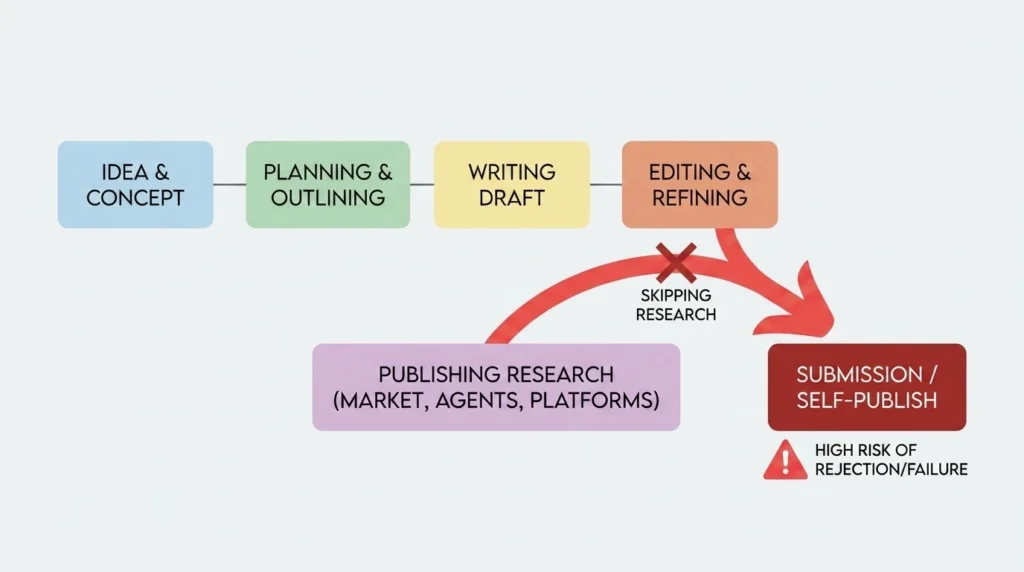
Mistake #7: Skipping the Research on Publishing
The Publishing Landscape Is More Complex Than You Think
First-time authors often assume that once the writing is done, publishing is simple. You just… send it somewhere, right? Not quite. The publishing world has its own language, its own gatekeepers, and its own timeline — and walking in unprepared will cost you months of wasted effort.
Traditional publishing requires query letters, literary agents, submission windows, and enormous patience. Self-publishing requires understanding formatting, distribution, marketing, and metadata. Neither path is “easier” — they’re just different.
If you want to skip the learning curve, working with book publishing services in USA can help you navigate whichever path makes sense for your goals. The key is not to walk in blind.
Mistake #8: Writing Alone When You Don’t Have To
Why Isolation Stalls the Writing Process
There’s a romantic idea that writing is a solitary art — just you, your thoughts, and a blank page. And while the actual writing is often a solo activity, the best books rarely come from pure isolation.
Writing groups, beta readers, critique partners — these are tools that have shaped careers. Even professional authors with decades of experience rely on feedback to catch blind spots. When you’re too close to your own work, you lose the ability to see it clearly. You know what you meant to say, so you read it the way you wrote it, not the way a stranger will read it.
If you’re working on a project but struggling to find your voice or maintain consistency, affordable ghostwriting services USA can be a game-changer. Collaboration isn’t cheating — it’s wisdom.
Mistake #9: Letting Fear Drive the Writing Process
The Emotional Truth Behind Every Strong Story
Fear is the number one reason first-time authors abandon their manuscripts. Fear of judgment, fear of failure, fear that the idea isn’t good enough. And here’s the thing — that fear doesn’t go away, even for experienced writers. You just learn to write through it.
The most powerful writing comes from vulnerability. The moments where you write something that scares you a little, something that feels too honest or too raw — those are usually the scenes that move readers most. Emotional truth is what separates forgettable fiction from stories that stay with people for years.
Give yourself permission to make mistakes in the first draft. No one has to see it. Write the messy, imperfect version first — you can fix it later. But you can’t fix a blank page.
Mistake #10: Misunderstanding the Role of Backstory
When to Share Character History — and When to Hold Back
Backstory is one of fiction writing’s trickiest tools. Used well, it deepens your character and creates emotional resonance. Used poorly, it stops your story dead in its tracks.
First-time authors tend to front-load backstory — they want readers to know everything about the character before the story begins. But readers don’t need that. They need to be curious about the character. Give them just enough to care, and reveal the rest as the story demands it.
A character’s personality and emotional struggle should be visible through their choices and reactions, not through paragraphs of explanation. Trust your readers. They’ll connect the dots if you give them the right pieces at the right moments.
One Last Thing: Give Yourself the Gift of Getting It Wrong
Every published author you admire has a drawer full of failed drafts, abandoned projects, and cringe-worthy early work. Writing is a craft that takes time to develop, and common writing mistakes are part of the process — not proof that you don’t belong.
What separates the authors who finish books from the ones who don’t isn’t talent. It comes down to stubbornness — showing up even when the story feels broken, and being willing to rewrite the chapter that isn’t working, even when you love individual sentences in it.
If you’re a first-time author working on your manuscript right now, the fact that you’re reading about storytelling craft, pacing, character development, and narrative structure tells me you’re already ahead of where most writers start. Keep going. The book you’re trying to write is worth finishing.
And if you need support along the way — whether it’s editing, publishing guidance, or just someone to help you think through your story — there are professionals who genuinely love this work and want to see your manuscript become a book people can hold in their hands.
About This Post: This article is written for aspiring novelists and first-time authors navigating the fiction writing process. It covers core storytelling concepts, including plot structure, character motivation, conflict, point of view, pacing, and the revision process — all key elements of writing craft that determine whether a manuscript succeeds or stalls.
Top 5 FAQs for “common writing mistakes”)
1. What are the most common writing mistakes?
The most common writing mistakes include weak story structure, lack of character motivation, poor pacing, missing conflict, and skipping the revision process. These issues reduce clarity, weaken storytelling, and make it harder for readers to stay engaged.
2. Why do first-time authors make common writing mistakes?
First-time authors make common writing mistakes because they often start writing without a clear plan, lack experience with storytelling techniques, and underestimate the importance of editing and revision. Without structure, even strong ideas can feel incomplete.
3. How can I avoid common writing mistakes?
You can avoid common writing mistakes by creating a clear outline, focusing on strong character development, adding conflict and stakes, and revising your manuscript carefully. Getting feedback from editors or other writers also helps improve quality.
4. What is the biggest mistake in writing a book?
The biggest mistake in writing a book is starting without a clear direction or structure. Without an outline or story plan, writers often lose focus, leading to unfinished drafts or confusing narratives.
5. Do editing and revisions help fix writing mistakes?
Yes, editing and revisions are essential for fixing writing mistakes. The first draft usually contains issues with structure, pacing, and clarity, and revising allows you to improve your story, strengthen characters, and refine your writing.