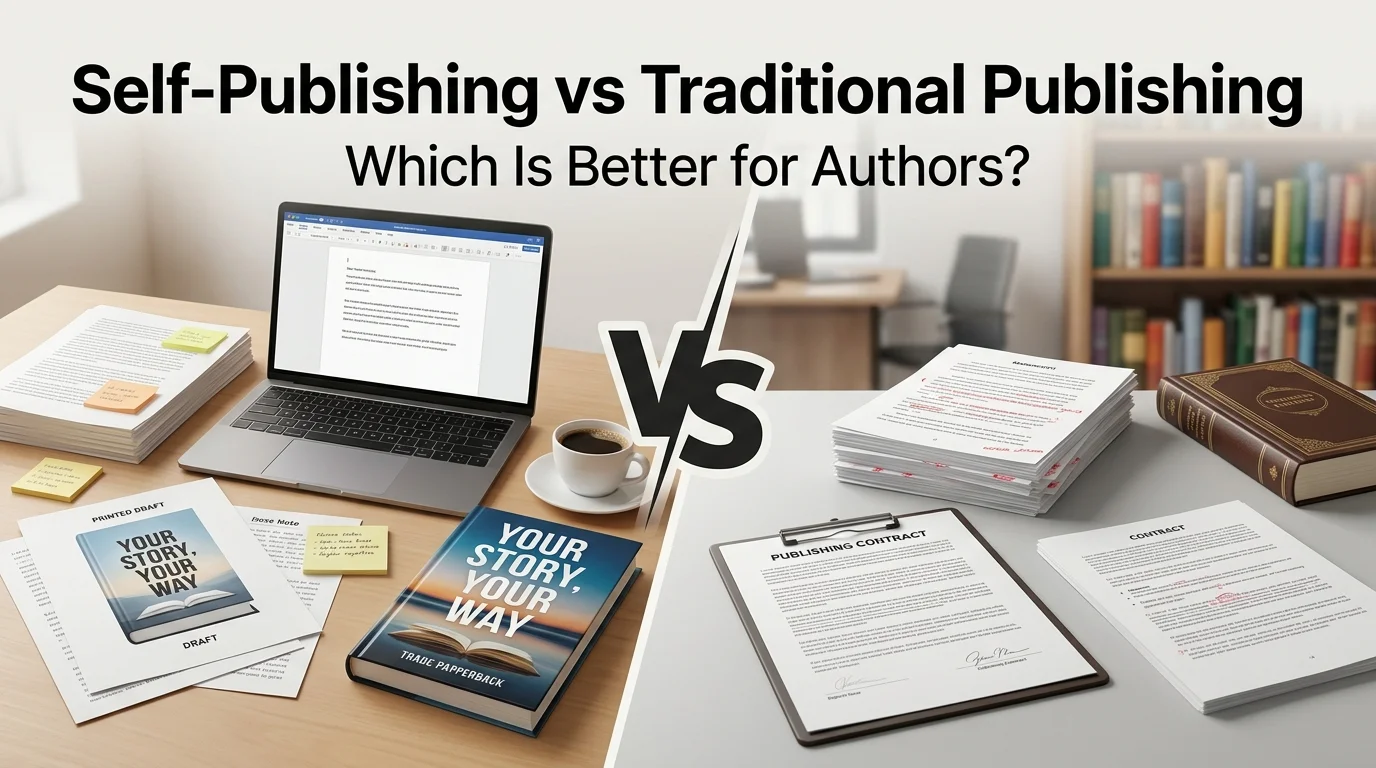
Self-Publishing and Traditional Publishing are the two main ways authors publish a book. Self-publishing gives authors full control, faster publication, and higher royalty potential, while traditional publishing offers professional editorial support, wider distribution, and stronger industry credibility. The better option depends on an author’s goals, budget, timeline, and how much control they want over the publishing process.
Choosing between Self-Publishing and Traditional Publishing is one of the biggest decisions an author can make. Both options can help you turn a manuscript into a real book, but they work in very different ways. Self-publishing gives authors more control, faster release, and higher royalty potential. Traditional publishing offers professional support, wider industry access, and stronger publishing credibility. The better option depends on your goals, budget, timeline, and how involved you want to be in the publishing process.
For many writers, this decision is not just about getting a book published. It is about ownership, income, creative freedom, editorial guidance, and long-term career growth. Some authors want complete control over the cover, pricing, and release schedule. Others want the backing of a publishing house, agent relationships, bookstore distribution, and a team that can guide the process. That is why understanding Self-Publishing and Traditional Publishing clearly can help you make a smarter choice for your book and your future as an author.
What Is the Difference Between Self-Publishing and Traditional Publishing?
What self-publishing means
Self-publishing means the author takes responsibility for publishing the book without handing the rights and process over to a traditional publisher. In most cases, the author either manages the work personally or hires freelancers and service providers for editing, formatting, cover design, and marketing. The author usually controls the manuscript, title, cover, publishing date, pricing, and distribution choices.
This path has become more popular because it gives writers direct access to readers through platforms like Amazon KDP and other print-on-demand or ebook systems. It also allows authors to move faster and keep a bigger share of royalties. For writers who want flexibility and creative control, self-publishing can be a strong option.
“The Authors Guild is a respected author organization, and its guidance on what traditional publishers do is highly relevant to your article topic. It is not a spammy affiliate or low-quality blog.” traditional publishing guidance for authors
What traditional publishing means
Traditional publishing means a publishing company acquires the book and takes over much of the production and distribution process. In many cases, authors first look for a literary agent, who then submits the manuscript to publishers. If a publisher accepts the project, the author signs a publishing contract. The publisher may provide editing, cover design, printing, distribution, and some level of marketing support.
This route is often seen as more established and more selective. It can bring industry recognition and easier access to bookstores, media opportunities, and professional publishing networks. At the same time, authors usually have less control over the final product and earn a smaller percentage of each sale.
Why authors compare these two publishing paths
Writers compare these paths because each one solves a different set of problems. Some authors want speed, ownership, and freedom. Others want validation, professional structure, and broader market reach. The question is not simply which one is better in general. The real question is which one is better for your goals, genre, budget, and expectations.
Self-Publishing and Traditional Publishing at a Glance
Speed to publish
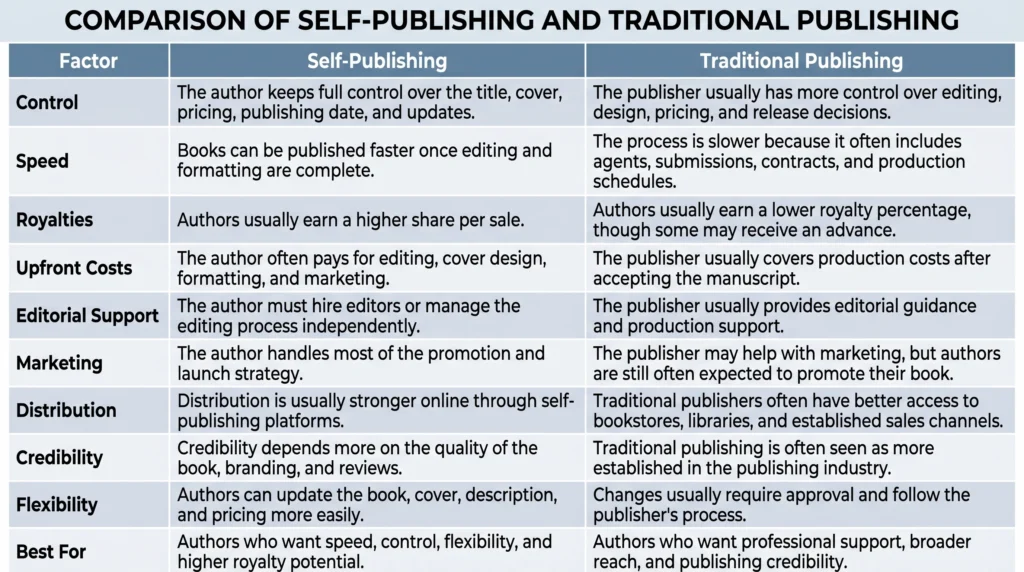
Self-publishing is usually much faster. Once your manuscript is ready, the process can move quickly if editing, design, and formatting are complete. Traditional publishing usually takes much longer because it often includes querying agents, waiting for responses, publisher review, contract negotiation, and a formal production schedule.
Creative control
Self-publishing gives authors full control over the cover, interior layout, title, subtitle, pricing, and release plan. Traditional publishing often involves shared or limited control because the publisher has the final say on many business and design decisions.
Royalties and earnings
Self-publishing often gives authors a higher royalty percentage per sale. Traditional publishing usually offers lower royalties, but some authors may receive an advance against future earnings. That difference makes income a major point in the Self-Publishing and Traditional Publishing debate.
Upfront costs
Self-publishing often requires the author to pay for editing, formatting, cover design, and marketing. Traditional publishing usually covers these production costs, although the author may still invest in personal marketing or brand-building work.
Marketing and promotion
Many new authors assume a traditional publisher will handle all promotion, but that is not always true. Even traditionally published authors are often expected to build an author platform and support book marketing. Self-published authors usually carry more direct responsibility for promotion, but they also have more freedom in how they market their work.
Distribution and reach
Traditional publishing often has stronger access to bookstores, libraries, distributors, and industry channels. Self-published books can still reach readers worldwide, especially online, but physical distribution may be more limited unless the author builds it strategically.
Benefits of Self-Publishing for Authors

Full control over your book
One of the biggest advantages of self-publishing is complete creative control. You decide how your book looks, when it launches, what edits are accepted, and how it is priced. For authors who care deeply about their vision, this level of control can be a major benefit.
Faster publishing timeline
Self-publishing allows authors to move at their own pace. You do not have to wait for agent replies or publisher decisions. Once your manuscript is polished and ready, you can publish much sooner. This matters for writers who want quick market entry, authors with time-sensitive topics, or those building a business around books.
Higher royalty potential
Self-publishing often offers a higher share of earnings per book sold. While the author may need to invest money upfront, the long-term income potential can be attractive, especially if the book sells consistently. Authors who understand pricing, reader demand, and digital publishing platforms may find this model financially rewarding.
Freedom to update your book anytime
Self-published authors can often revise their book, update the cover, improve the description, or adjust pricing whenever needed. That flexibility is useful if you want to improve your book after launch or respond to market feedback.
Benefits of Traditional Publishing for Authors
Professional publishing support
Traditional publishers often provide editorial guidance, production support, design resources, and project management. This can be helpful for authors who want expert oversight and a more structured path from manuscript to finished book.
Stronger bookstore access
A traditional publisher usually has existing relationships with distributors, wholesalers, bookstores, and industry contacts. That can improve the book’s reach in physical retail settings and other established channels.
Industry credibility
Traditional publishing still carries weight in many parts of the book world. For some authors, especially those writing literary fiction, academic work, or books aimed at media attention, traditional publishing may offer stronger status and visibility.
Less direct production management
With traditional publishing, the author does not usually need to manage every service provider. The publisher handles much of the process. That can reduce stress for authors who prefer to focus on writing rather than project coordination.
Challenges of Self-Publishing

You handle the publishing process yourself
Self-publishing gives you freedom, but it also gives you responsibility. You need to make decisions about editing, cover design, interior formatting, metadata, pricing, and launch planning. Some writers enjoy that control, but others find it overwhelming.
Editing, cover, and formatting costs
A professional book still needs quality editing and presentation. If you choose self-publishing, you may need help from professionals. Strong editorial work can improve the manuscript, and a polished release often depends on good production. Authors who need support with drafting or polishing can explore book writing services USA or book editing services usa to strengthen the final result before publication.
Marketing depends heavily on the author
Self-published authors often need to manage much of their own marketing. That can include building an email list, running promotions, reaching reviewers, creating launch plans, and improving discoverability. Without a clear strategy, even a good book may struggle to gain traction.
Competition is higher on self-publishing platforms
Digital publishing platforms are crowded. Thousands of books compete for visibility, especially in popular genres. That means authors need strong positioning, a clear category fit, and professional presentation to stand out.
Challenges of Traditional Publishing
Long waiting times
Traditional publishing can be slow. Querying agents may take months. Publisher review can take even longer. After acceptance, the release schedule may still be far away. For authors who want speed, this can be frustrating.
Less creative control
Traditional publishers may change titles, covers, positioning, or editorial direction. These decisions are often based on market strategy, not only author preference. Some writers are comfortable with that trade-off, while others are not.
Lower royalty percentages
Traditional authors usually earn lower royalties per sale than self-published authors. Even with professional support, the smaller percentage matters when comparing long-term income.
Harder acceptance for new authors
Traditional publishing is competitive. Many manuscripts are rejected, and even strong books may struggle to find representation. That does not mean the model is bad, but it does mean the path is not equally accessible to everyone.
Which Publishing Option Makes More Money?
How self-publishing royalties work
In self-publishing, the author often receives a larger share of each sale. That can make the model appealing, especially for authors who plan to build a long-term catalog. Higher royalties can be powerful when paired with good pricing, smart positioning, and strong reader targeting.
How traditional publishing royalties work
Traditional publishing usually offers lower royalty percentages. Some authors receive an advance, which can be helpful, but not every book earns beyond that amount. The financial structure often depends on the contract, format, and publisher terms.
Why total earnings depend on the author’s goals
Money is not only about royalty rate. Sales volume, distribution, visibility, rights, and long-term strategy also matter. A self-published author may earn more per copy but sell fewer copies in some cases. A traditionally published author may have wider access but earn less per sale. That is why the better earning path depends on your audience, business model, and publishing plan.
Which Option Gives Authors More Control?
Control over content and editing
Self-publishing gives authors the final word on the manuscript, revisions, and editorial direction. Traditional publishing often includes editorial decisions shaped by the publisher’s standards and market goals.
Control over cover and formatting
In self-publishing, authors choose the design team and approve the final look. In traditional publishing, the publisher often leads these decisions. For authors who care deeply about branding and presentation, that difference is important.
Control over pricing and publishing schedule
Self-published authors can often adjust pricing and launch dates more freely. Traditional publishing follows internal schedules, sales strategies, and release calendars that the author may not control.
Which Publishing Path Is Better for First-Time Authors?
When self-publishing may be the better choice
Self-publishing may be better for first-time authors who want speed, control, and direct ownership. It can also work well for writers in practical nonfiction, niche topics, business books, or genres where audience targeting matters more than industry approval.
When traditional publishing may be the better choice
Traditional publishing may be better for authors who want professional support, bookstore placement, and established publishing recognition. It can also be appealing for writers who are prepared for a longer process and want the validation that comes from acceptance by an agent or publisher.
How to choose based on your goals
A first-time author should think beyond emotion and focus on purpose. Are you trying to build a personal brand, share expertise, create passive income, gain literary recognition, or reach a specific market? The answer helps clarify whether Self-Publishing and Traditional Publishing makes more sense for your book.
Self-Publishing and Traditional Publishing for Different Author Goals
Best option for authors who want speed
Self-publishing is usually the better choice for authors who want a faster route to market.
Best option for authors who want credibility
Traditional publishing may feel stronger for authors who want industry status and broader institutional recognition.
Best option for authors who want higher royalties
Self-publishing often makes more sense for authors who prioritize royalty percentage and long-term control.
Best option for authors who want full control
If control over content, cover, schedule, and strategy matters most, self-publishing is usually the better fit.
Self-published authors also need to make important production decisions, and that includes choosing the right help for editing, design, and formatting. If you are unsure where to start, read our guide on How to Choose a Professional Book Formatting Service for Your Book to understand what to look for before publishing.
How to Choose the Right Publishing Path for Your Book
Consider your budget
If you self-publish, plan for editing, design, formatting, and promotion costs. If you prefer a more guided route, you may want to explore book publishing services for new authors to understand what kind of support is available before making a final decision.
Consider your timeline
If you want to publish soon, self-publishing is often more practical. If you are willing to wait for agent submissions and contract timelines, traditional publishing may still be worth pursuing.
Consider your publishing experience
Some authors are comfortable managing freelancers, platforms, metadata, and launch tasks. Others prefer hands-on guidance. Your confidence level matters.
Consider your long-term goals
A book is not only a product. It can also be part of a larger author career, business strategy, or personal mission. Think about where you want your writing to take you over the next few years, not just the next few months.
Final Verdict on Self-Publishing and Traditional Publishing
Self-publishing is better for some authors
Self-publishing is often better for authors who want speed, ownership, flexibility, and stronger royalty potential. It suits writers who are comfortable making business decisions and actively managing their publishing path.
Traditional publishing is better for others
Traditional publishing is often better for authors who want editorial structure, bookstore access, industry support, and the credibility of a recognized publishing house. It suits writers who are patient and open to sharing control.
The right choice depends on your goals
There is no single answer that fits every author. The best choice depends on your priorities. If control, speed, and earnings matter most, self-publishing may be the stronger path. If support, reach, and established publishing systems matter more, traditional publishing may be the better fit. The smartest decision is the one that matches your book, your audience, and your long-term goals as an author.
Frequently Asked Questions
Is self-publishing better than traditional publishing?
Self-publishing is better for authors who want more control, faster release, and higher royalty potential. Traditional publishing is better for authors who want professional support, wider industry access, and established credibility.
Do self-published authors make more money?
They can make more money per copy because royalty percentages are often higher. However, total earnings depend on sales, marketing, audience reach, and overall publishing strategy.
Is traditional publishing harder to get into?
Yes, traditional publishing is generally more competitive because authors often need a strong manuscript, agent interest, and publisher approval before a book is accepted.
Which publishing option is faster?
Self-publishing is usually much faster because the author controls the timeline and does not need to wait for an agent or publisher decisions.
Which publishing path is best for first-time authors?
It depends on the author’s goals. First-time authors who want speed and control may prefer self-publishing. Those who want industry backing and formal support may prefer traditional publishing.
In the end, the debate around Self-Publishing and Traditional Publishing is really about fit. A well-written book can succeed through either path when the publishing choice matches the author’s goals, resources, and expectations.